China’s stainless welding market has expanded rapidly, but supplier quality remains uneven. This guide examines China’s top 10 stainless flux cored MIG suppliers through practical, measurable criteria. Product range matters. So does process control.
The focus is Mig Welding Stainless Steel Flux Cored, especially applications involving 304, 316L, duplex, and heat-sensitive stainless components. Experienced fabricators know that attractive brochures cannot replace stable arc performance. A spool may look perfect while producing excessive spatter, poor slag release, or inconsistent ferrite balance.
Dr. Duane K. Miller, a respected welding engineer, has emphasized, “Welding is a manufacturing process, not merely a joining operation.” That principle shapes this comparison. We consider AWS or EN classifications, wire diameter consistency, shielding-gas recommendations, moisture protection, batch traceability, and technical support. Factory audits, sample welds, and independent test reports deserve serious attention.
Real workshop details reveal more than slogans. Can the wire feed smoothly through a six-meter liner? Does the weld remain clean after repeated starts? Are mill certificates supplied without hesitation? These questions expose weak suppliers quickly.
The ranking is not absolute. A supplier strong in heavy fabrication may not suit thin automotive panels. Price can also mislead. A cheaper kilogram may create more grinding, rework, and downtime.
Some evaluations remain imperfect because public supplier data changes frequently. Buyers should verify current certifications, production capacity, and delivered samples before making a final decision. This introduction provides a grounded starting point for that review.
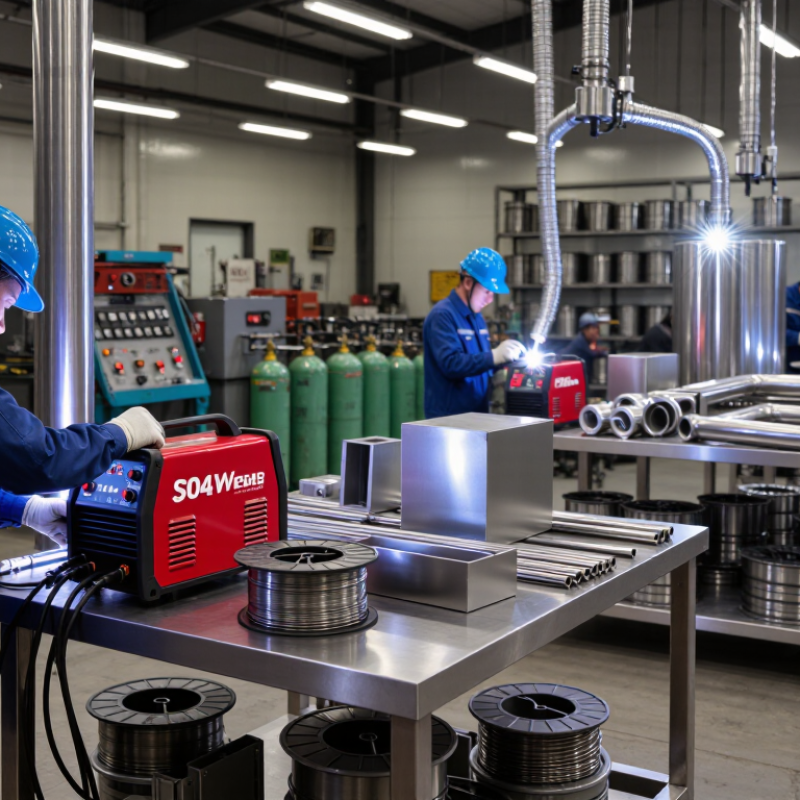
Stainless flux-cored MIG welding uses a tubular wire filled with mineral and alloying compounds. Technically, it is flux-cored arc welding, although many buyers call it flux-cored MIG. The wire melts continuously through a welding gun, while its flux forms shielding slag and supports arc stability. Some wires require external shielding gas; others operate without it. That difference affects equipment, wind tolerance, fumes, and operating cost.
When evaluating China-based suppliers, check the exact wire classification under recognized AWS or ISO standards. Ask for mill certificates, batch traceability, diameter tolerance data, and safety documentation. A reliable supplier should explain recommended current ranges, polarity, gas flow, storage humidity, and post-weld cleaning. Request samples in your actual thickness, such as 3 mm stainless plate with a 1.2 mm wire. Inspect penetration, bead shape, slag removal, spatter, and porosity under consistent settings.
Do not trust a polished catalog alone. I once reviewed a sample with attractive welds, but its lot records were incomplete. That was a warning. Supplier audits should cover raw-material control, drying ovens, winding tension, laboratory testing, and sealed packaging. Ask how complaints are investigated, not merely whether complaints exist. Delivery history, technical response time, and export documents also matter. A low price can hide unstable wire feeding or excessive slag. Small trial orders reveal more than confident promises. Your evaluation may still miss something. Record every result and retest before approving regular supply.
| No. | Evaluation Dimension | Relevant Technical Benchmark | Supplier Evidence to Request | Suggested Weight |
|---|---|---|---|---|
| 1 | Product Classification | Stainless flux-cored wires should be identified by an applicable classification under AWS A5.22 or EN ISO 17633. The designation should state the deposited weld-metal type and shielding condition. | Technical data sheet, classification certificate, wire designation, shielding-gas requirement, and confirmation of whether the product is gas-shielded or self-shielded. | 15% |
| 2 | Stainless Grade Coverage | Common stainless flux-cored consumable families include grades corresponding to 308L, 309L, 316L, and 347. The selected grade must match the base metal and service environment. | Product matrix covering weld-metal chemistry, compatible base materials, operating temperature, corrosion requirements, and recommended applications. | 12% |
| 3 | Chemical Composition Control | Stainless filler metals require controlled chromium, nickel, molybdenum, carbon, manganese, silicon, and other alloying elements according to the applicable classification. | Heat-lot chemical analysis, certificate of conformity, sampling procedure, and traceability from raw material to finished spool. | 12% |
| 4 | Welding Performance | Relevant performance indicators include arc stability, slag detachability, bead appearance, spatter level, deposition rate, and suitability for the specified welding positions. | Welding procedure test records, parameter ranges, deposition-rate data, position capability, and sample welds produced with the proposed shielding gas. | 12% |
| 5 | Mechanical Properties | Tensile strength, yield strength, elongation, impact toughness, and ferrite or microstructural requirements must be evaluated against the applicable wire classification and project specification. | Independent or laboratory test reports, weld-metal tensile results, impact-test temperature, hardness data where required, and procedure qualification records. | 12% |
| 6 | Corrosion and Metallurgy | Austenitic stainless weld metal may require ferrite control to reduce hot-cracking risk. Duplex or special-alloy applications require additional control of phase balance and heat input. | Ferrite measurement method, ferrite-number records where applicable, metallographic reports, corrosion-test data, and application-specific welding recommendations. | 10% |
| 7 | Dimensional and Feeding Quality | Consistent wire diameter, surface condition, cast, helix, and flux filling are important for stable wire feeding and repeatable welding results. | Diameter-tolerance data, cast-and-helix inspection records, feeding tests, spool photographs, batch inspection reports, and packaging specifications. | 9% |
| 8 | Quality Management | ISO 9001 is a recognized quality-management framework. Certification alone does not prove product performance, but it supports documented process control and corrective action. | Valid quality-management certificate, certificate scope, internal inspection plan, nonconformance procedure, calibration records, and customer complaint response process. | 7% |
| 9 | Packaging and Storage | Flux-cored wire can be affected by moisture, contamination, and mechanical damage. Packaging should protect the wire during storage, transport, and workshop use. | Moisture-control procedure, sealed-package specification, recommended storage conditions, shelf-life statement, labeling system, and packaging drop or transport test results. | 6% |
| 10 | Export and Technical Support | International projects may require multilingual documentation, stable lot traceability, export documentation, welding procedure support, and compatibility with commonly used power sources. | Technical support process, response-time commitment, export documentation sample, lot-traceability example, application engineer availability, and after-sales records. | 5% |
It uses tubular stainless wire filled with mineral and alloying compounds. The wire melts continuously through a welding gun. Flux creates shielding slag and supports arc stability. Some wires require external shielding gas. Others do not.
Gas requirements affect wind tolerance, fumes, equipment, and operating costs. Ask for the exact gas type and flow rate. Do not guess.
Request wire classification, mill certificates, batch traceability, diameter tolerance data, and safety documents. Certificates should match the grade, factory, and batch. A certificate alone proves little.
Use your actual material and thickness, such as a 3 mm stainless plate with 1.2 mm wire. Inspect penetration, bead shape, slag removal, spatter, and porosity. Keep welding settings consistent. Small tests reveal problems.
Check raw-material control, flux filling, drying ovens, winding tension, laboratory testing, and sealed packaging. Ask how moisture is controlled. Look for batch codes linking spools to inspection records.
Compare arc stability, spatter, slag release, bead appearance, and deposition efficiency. Also review delivery history and technical response time. A low price may hide unstable feeding or excess slag.
No. Verify recent test reports, sample welds, and production conditions. Certifications support evaluation, but they cannot replace testing. I have seen attractive samples with incomplete lot records.
Start with a small trial order before long-term purchasing. Confirm packaging strength, storage instructions, export documents, and complaint response times. Record every result. Retest before approving regular supply.
Vague specifications, missing lot records, unclear gas guidance, or slow technical replies deserve attention. Polished catalogs can mislead. Your evaluation may still miss something.
This article presents a practical guide to China’s top stainless flux-cored MIG suppliers, beginning with the fundamentals of Mig Welding Stainless Steel Flux Cored and the key factors used to evaluate suppliers. It explains how manufacturers can be assessed through product consistency, welding performance, material compatibility, production capacity, quality control, certifications, and export experience.
The comparison focuses on stainless flux-cored wire quality, available specifications, application suitability, pricing structure, packaging, technical support, and international delivery services. It also outlines how to select the right supplier according to project requirements, welding equipment, purchasing volume, required standards, and long-term cooperation goals. By combining technical evaluation with commercial considerations, buyers can make a more informed decision and identify a dependable Chinese supplier capable of providing stable products, responsive service, and consistent support for stainless steel welding applications.

 Runxing machinery